
Smart AI Blog Summary
Get a quick blog summary from any of the below LLM's
Ask a sales rep what they struggle with in roleplay and they will give you a list in under thirty seconds. Objection handling. Clinical pushback. Going off script when the customer says something unexpected.
But ask them what they find easy, and something interesting happens. They pause. Think about it. And then they tell you something genuinely useful.
That question, what comes naturally to you in a customer conversation, is one of the most underused tools in sales coaching. It surfaces real strengths that most training programs never think to build on. And for managers, the answers are often more revealing than any skills assessment.
This article is about those answers. What sales reps across B2B teams consistently say they find easiest in roleplay conversations, what that tells us about how they are wired, and how great managers use that information to develop more confident, capable field teams.
Why This Question Changes the Coaching Conversation
Most sales coaching starts with a gap. What did the rep miss? Where did the conversation break down? What needs fixing before the next call?
That is a necessary conversation. But it is not the only one worth having.
When you ask a rep what they find easy in a customer conversation, you shift the dynamic entirely. The rep stops defending and starts reflecting. They tell you where their confidence lives. And that information is gold, not just for the rep, but for the manager designing their development path.
In pharma sales, this matters even more. A rep who knows they are naturally good at building early rapport with a physician but struggles when clinical evidence gets challenged needs a very different coaching plan than one who handles clinical depth comfortably but freezes under time pressure. Both gaps are real. But the starting point for each is completely different.
The best managers do not just coach to weaknesses. They coach from strengths outward. And it all starts with asking the right question.
What Reps Consistently Say Comes Naturally to Them
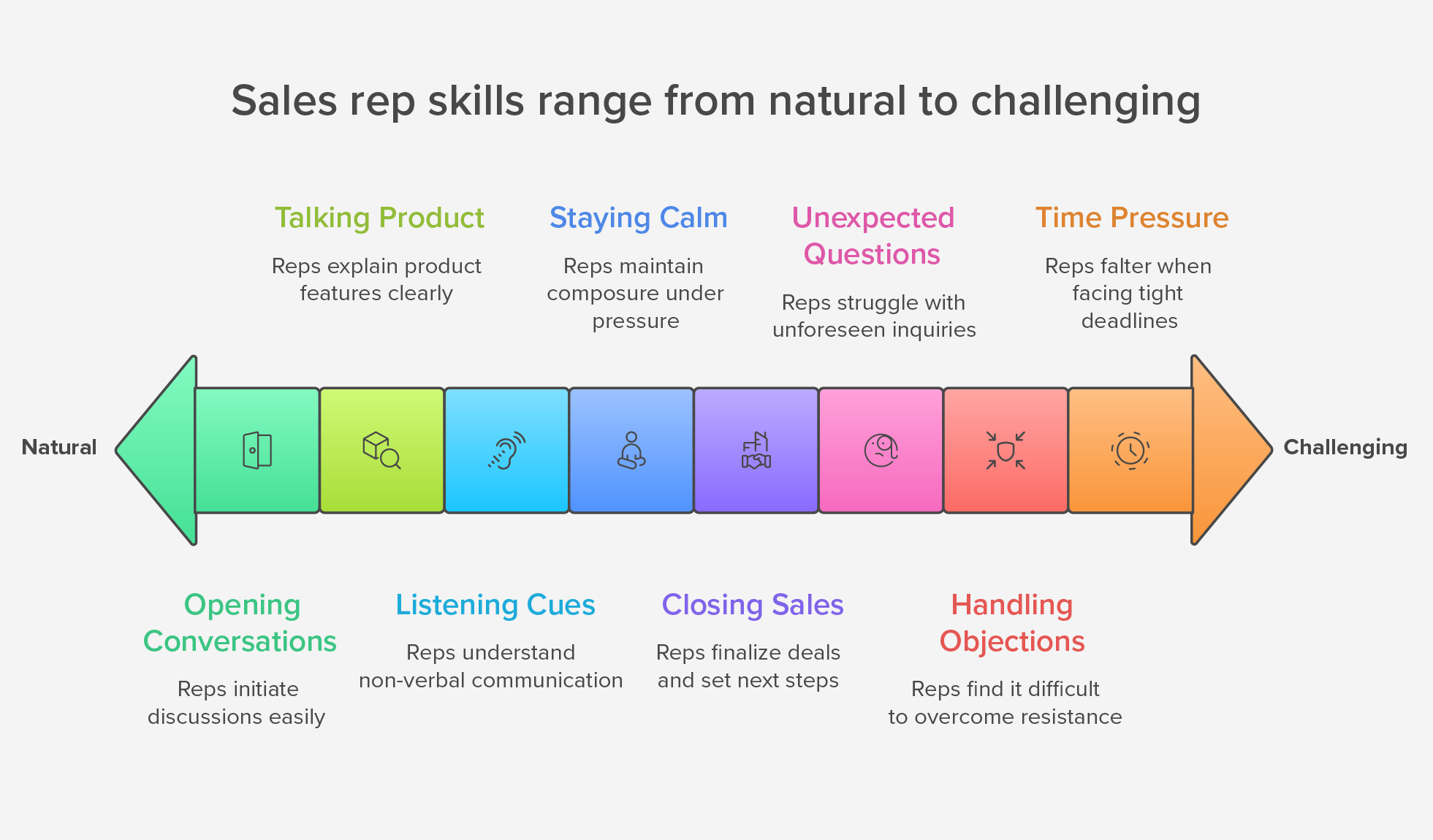
Across B2B sales teams, there are five things reps most consistently say they find easiest when they step into a customer roleplay conversation. They are not always what managers expect.
What Feels Easy | What Reps Actually Say |
|---|---|
Opening the conversation | "I know how to break the ice. Starting a call feels natural to me." |
Talking about the product | "When I know the product well, that part flows. I feel in my element." |
Listening and picking up cues | "I notice when the customer shifts tone. I can read the room." |
Staying calm under pressure | "I do not panic. I can slow down and think even when it gets uncomfortable." |
Wrapping up and setting next steps | "Ending the conversation and agreeing on what happens next feels straightforward." |
These five come up time and again, across industries, experience levels, and team sizes. A few observations worth noting.
Opening the conversation feels natural to most reps because it is social, not technical. There is no clinical question at stake in the first thirty seconds. The rep is in their element as a human being, not yet as a subject matter expert.
Talking about the product feels easy specifically when the rep has done their homework. This is not overconfidence. It is the direct result of good preparation. In pharma, a rep who knows their product monograph inside out will tell you the clinical detail section of a conversation feels comfortable. What challenges them is when the physician takes the conversation somewhere the prep did not cover.
Listening and picking up cues is a strength that experienced reps develop without being explicitly taught. They read the room. They notice when interest drops or a question is really an objection in disguise. This is a natural skill that structured coaching can sharpen significantly.
Staying calm under pressure tends to be a personality trait more than a trained skill. Reps who have it know they have it. Those who do not are often the last to admit it.
Wrapping up and setting next steps feels easier than the middle of the conversation because the structure is clear. There is a natural endpoint. Reps feel less exposed here than during an unexpected clinical challenge mid-conversation.
What the Easy Parts Actually Tell Us
Here is where it gets interesting for managers and trainers.
When a rep says something feels easy, they are not just describing comfort. They are revealing how they process conversations, where their attention goes naturally, and what kind of support will actually move them forward.
A rep who finds opening easy but struggles mid-conversation is telling you their relationship instincts are strong but their technical resilience under pressure needs work. That is a coaching brief in one sentence.
A rep who finds product knowledge conversations easy but stumbles on wrapping up and setting next steps is telling you they get absorbed in the content and lose the thread of where the conversation needs to go. Again, a coaching brief hiding inside a compliment.
The implication for sales managers is clear: reps retain what they practice, and they practice best when they start from a place of confidence.
That last point is worth sitting with. Starting a coaching session from a rep's natural strength is not just good for morale. It is neurologically sound. Confidence in one part of a conversation creates a platform for tackling the harder parts.
Managers who skip this step and go straight to gaps often find their coaching does not stick, not because the rep is not trying, but because the foundation was never laid.
Where Easy Ends and Real Readiness Begins
Knowing what comes naturally is a starting point. It is not the finish line.
The honest reality in sales, and especially in pharma sales, is that the easiest parts of a roleplay conversation are almost never the moments that determine the outcome of a real customer interaction. What determines the outcome is what happens when things do not go to plan.
Here is where most reps land when the conversation moves past their comfort zone:
The Three Moments That Test Real Readiness
Moment 1: The unexpected clinical question
The physician asks something the rep did not prepare for. The product knowledge that felt so solid thirty seconds ago suddenly has a gap. This is where preparation meets pressure, and only repeated practice closes that distance.
Moment 2: The polite but firm objection
Not aggressive pushback. Just a calm, experienced clinician who says, "We are happy with what we are using." There is no obvious opening to push through. The rep must find one without being pushy or sounding scripted. This is a skill that almost nobody finds natural on the first attempt.
Moment 3: The time pressure moment
The physician glances at their watch. The conversation that was flowing comfortably suddenly has a thirty-second clock on it. Can the rep land the most important point cleanly under that pressure? Most cannot, until they have practiced it enough times that the response becomes instinctive.
These three moments do not show up in the easy list. They never do. And that is exactly why roleplay practice needs to go beyond what feels comfortable.
The goal is not to keep practicing what already works. The goal is to use what works as a foundation, and then systematically extend the rep's confidence into the moments that actually matter in the field.
A rep who opens conversations naturally can be coached to carry that same ease into the middle of a clinical challenge. A rep who listens well can be coached to use that listening skill to pick the right moment to address an objection. Natural strengths are not separate from professional development. They are the most efficient starting point for it.
How SmartWinnr Helps Teams Build on Natural Strengths
SmartWinnr's AI roleplay capabilities are designed to do exactly what this article describes. Not just identify where reps struggle but give managers the visibility to see where each rep's confidence already lives and build outward from there.
Reps practice realistic customer conversations in a safe, on-demand environment. They get specific, structured feedback after every session tied to observable behaviors, not general impressions. And because the practice is repeatable, reps can work through the moments they find hard as many times as they need to, without it feeling like a performance under observation.
For managers, SmartWinnr surfaces readiness data at an individual and team level. Which reps are progressing. Where confidence gaps appear consistently across a territory. What scenarios are producing the most consistent difficulty. That intelligence makes coaching conversations sharper, faster, and more grounded in what is actually happening, rather than what a manager last happened to observe on a ride-along.
For sales teams preparing for a product launch, onboarding a new cohort, or looking to build more consistent field confidence across their territories, SmartWinnr offers a practical and structured starting point.
Request a demo to understand how SmartWinnr supports sales team readiness through AI roleplay, strength-based coaching, and compliant skill reinforcement.